Light that responds to the scene
Surface reflections, dynamic lighting, and dynamic shadows give glass, metal, and opaque materials their character. Path tracing brings these interactions together as objects and the camera move.
Real-time path-traced materials, dynamic volumetrics, and interactive physics in one engine. Explore reflective glass and metal, light moving through fog, a deformable basketball, and destruction that changes the scene.
Glass that catches the room. Fog that carries light. Objects that bend, bounce, and break.
Surface reflections, dynamic lighting, and dynamic shadows give glass, metal, and opaque materials their character. Path tracing brings these interactions together as objects and the camera move.
Transparent glass spheres combine transmission and reflections. A dedicated glass-fog pass follows reflected and refracted rays through the volume, bringing the surrounding atmosphere into intact glass spheres and panes.
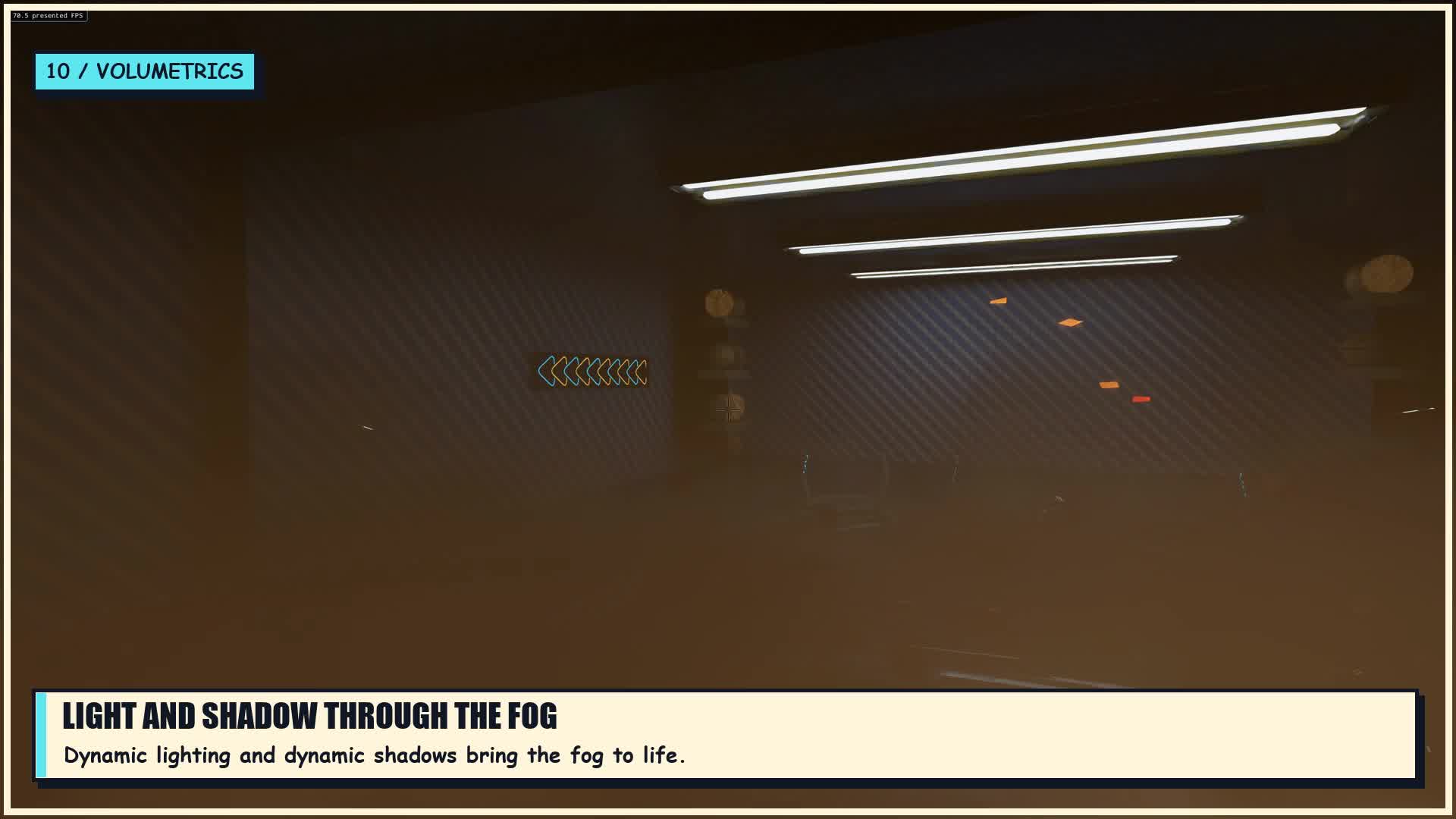
NVIDIA Flow drives evolving smoke and fog. Sparse-volume rendering adds dynamic lighting and dynamic shadows within the volume, while volumetric ReSTIR reuses light-transport samples across space and time.
DLSS 4.5 + Ray Reconstruction supports the surface rendering path. Volumetrics combine ReSTIR sampling with an optional recurrent neural denoiser deployed through TensorRT and CUDA. NRD denoisers are also integrated for surface rendering.
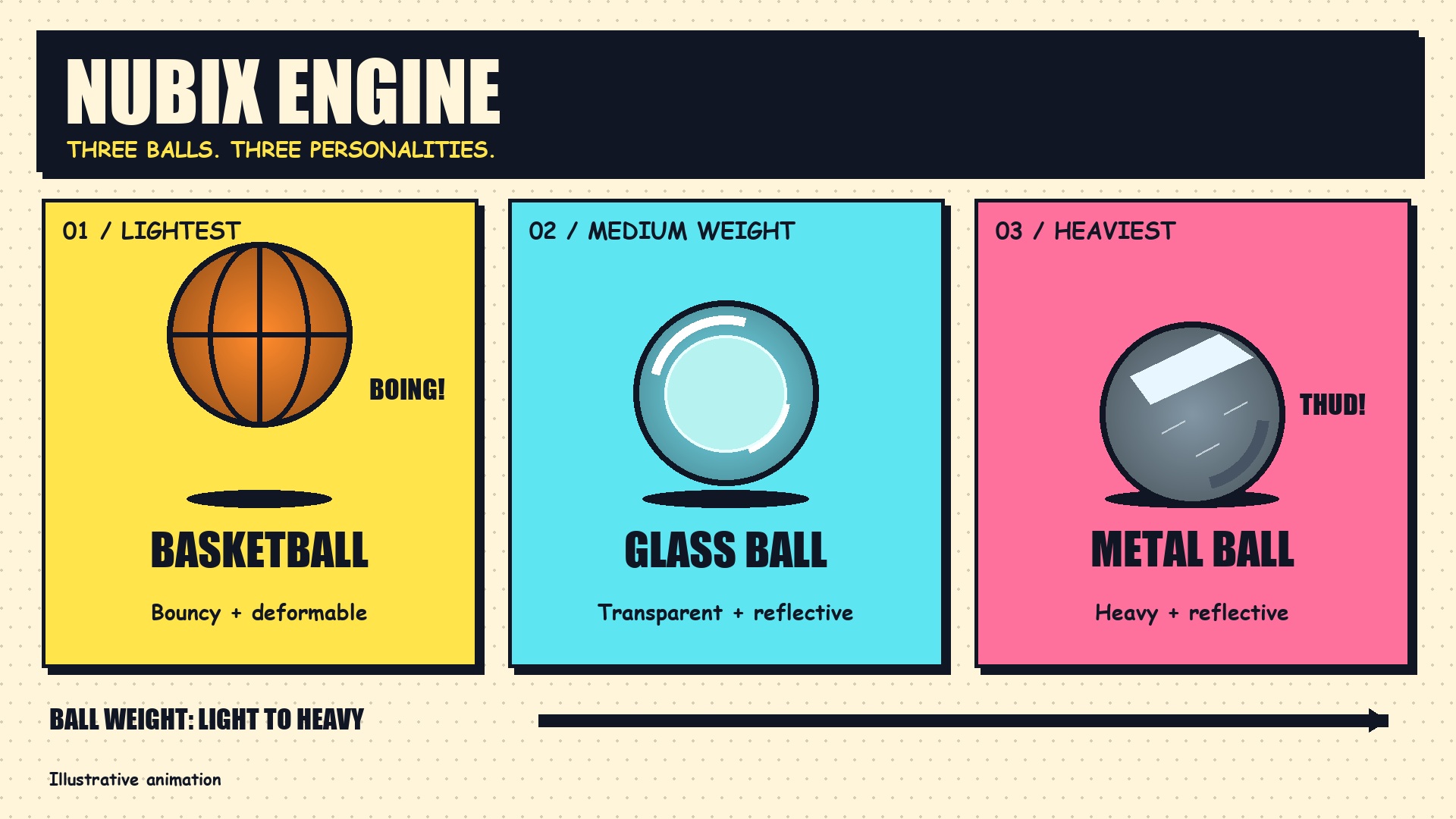
A FleX soft-body basketball deforms and bounces. Glass and metal balls use rigid-body dynamics, with different throw weights and material responses. PhysX handles collisions and the interaction of objects throughout the scene.
Blast turns collision-driven damage into fractured chunks and broken bonds. PhysX carries those pieces into the simulation, connecting a thrown object to a visible, physical change in the environment.
Nubix exceeded 40 FPS before generated frames were counted. In a separate default-scene benchmark, frame generation off delivered 51.4 FPS. With 2× Multi-Frame Generation enabled, the engine delivered 42.4 rendered FPS and 84.7 presented FPS.
The FPS figures above come from a separate 1920 × 1080 benchmark on an RTX 5070 Ti with DLSS Balanced and Ray Reconstruction. The featured recording was captured in 4K HDR. Rendered FPS counts engine-rendered frames; presented FPS includes generated frames.
Real-time · 4K (3840 × 2160) · HDR capture. The featured recording uses 2× Multi-Frame Generation alongside DLSS 4.5 and Ray Reconstruction, with path tracing at one ray per pixel. Streamline and NVIDIA Reflex connect reconstruction to presentation; supported generation modes are selected according to GPU capability.
Generated frames improve presentation smoothness. Physics and input continue at the rendered-frame rate.
Nubix is my independent C++ engine, bringing DirectX 12 and HLSL rendering together with NVIDIA simulation and reconstruction technologies. The work spans GPU resource lifetimes, rendering passes, physics integration, model training, and live validation.
Runtime controls expose lighting, fog, denoising, and frame-generation settings. Capture and profiling tools connect what appears on screen to the buffers, timings, and numerical checks behind it.
Read the PhysX & Blast integration article ↗Five archived comparisons from the rendering and reconstruction work. Original panel labels are preserved; select any image to inspect the full-resolution capture.
Three-scattering-event case from the static convergence audit. The original panels compare fresh sampling, individual reuse modes, and combined reuse against the native reference.
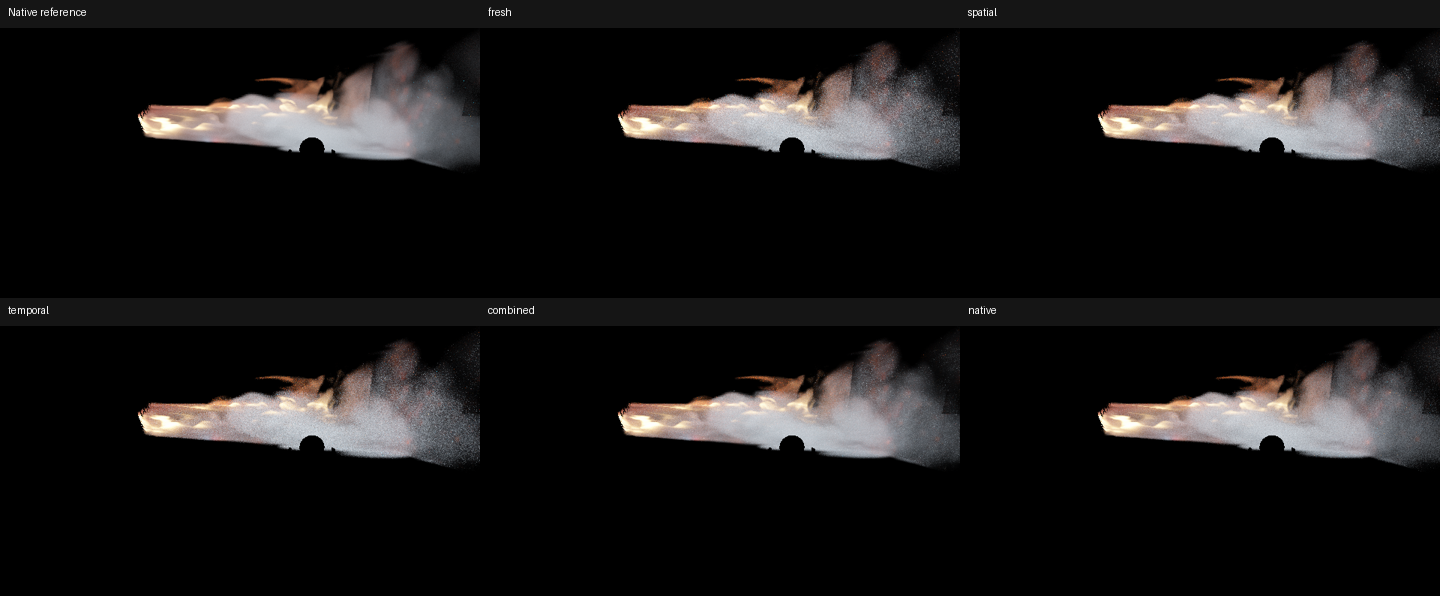
Seven-scattering-event dense-fog case from the same audit. This close view makes the noise structure across the labeled reuse modes easier to inspect.
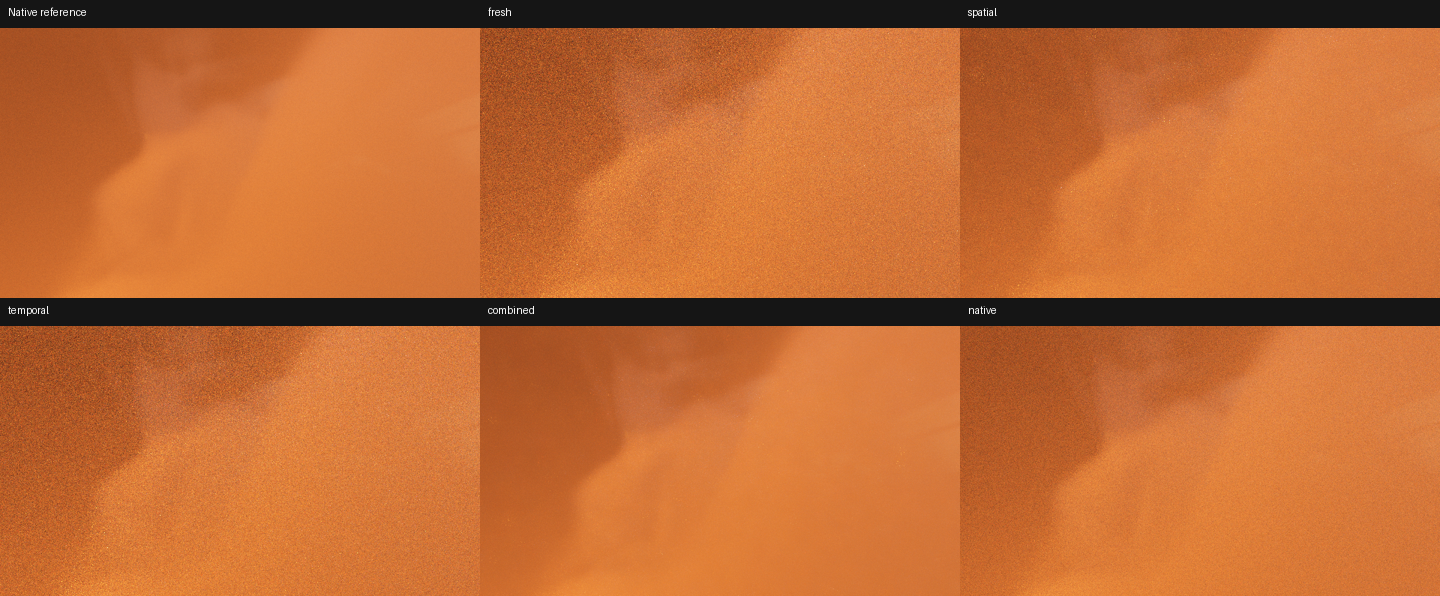
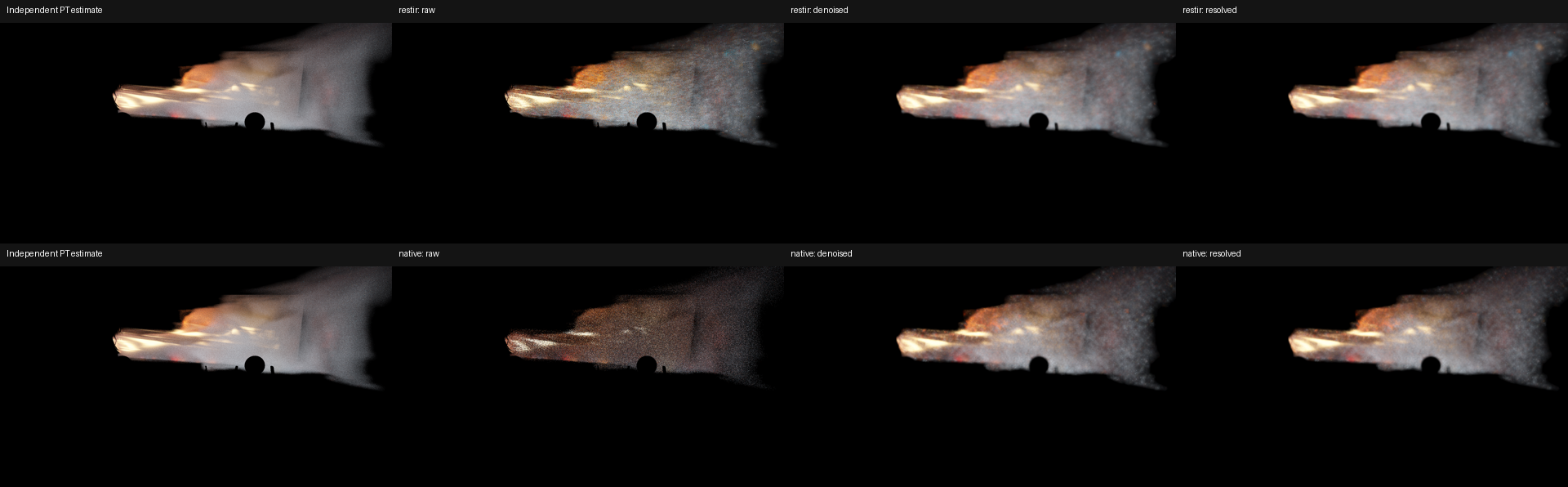
Earlier quality comparison showing the independent path-tracing estimate alongside raw, denoised, and resolved output. The top row uses ReSTIR; the bottom row uses native sampling.
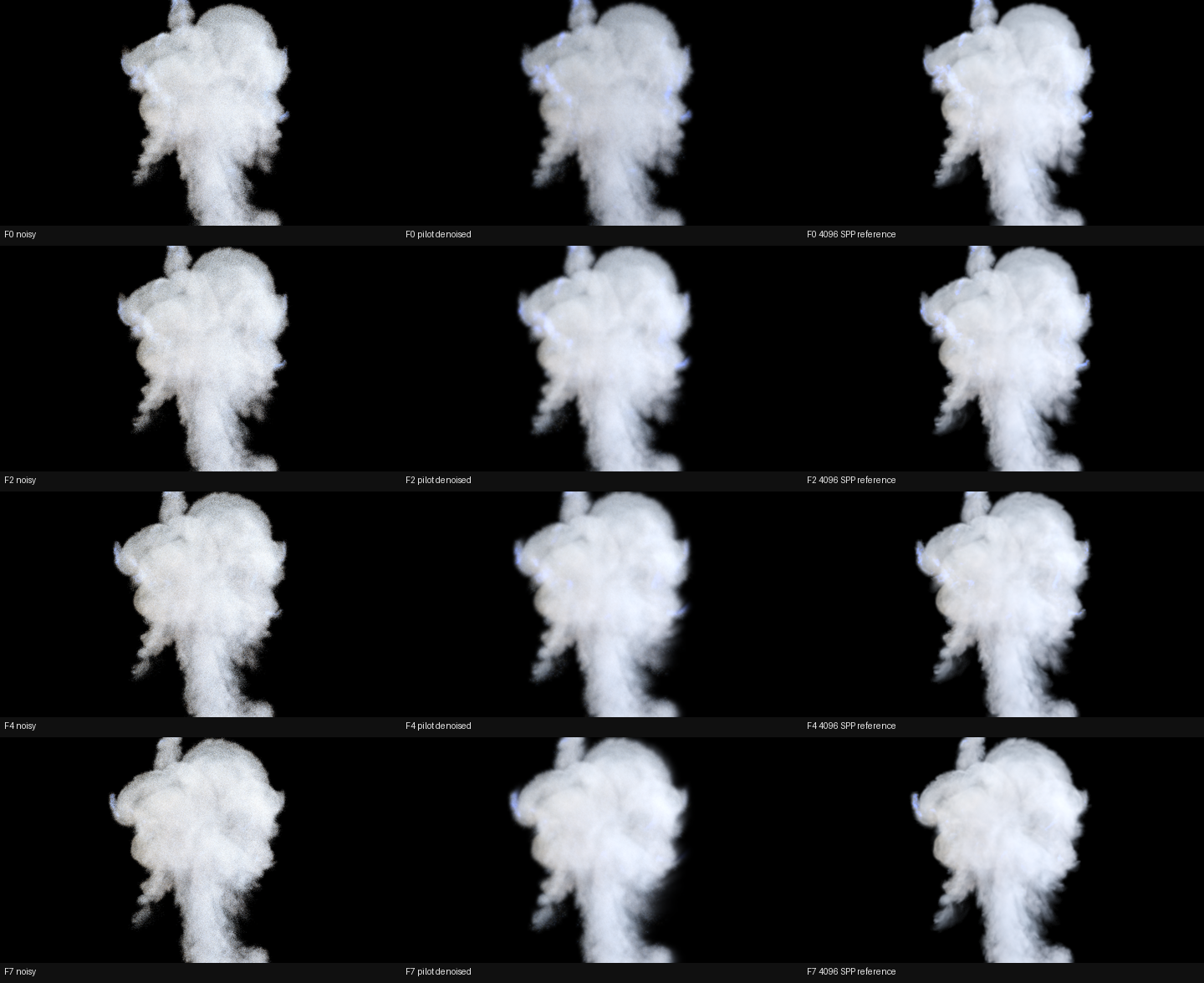
Earlier pilot-model validation preview for clip 0081. Frames 0, 2, 4, and 7 compare noisy input, neural reconstruction, and the 4,096-sample-per-pixel reference. This records the pilot model, rather than the later epoch-750 deployment.
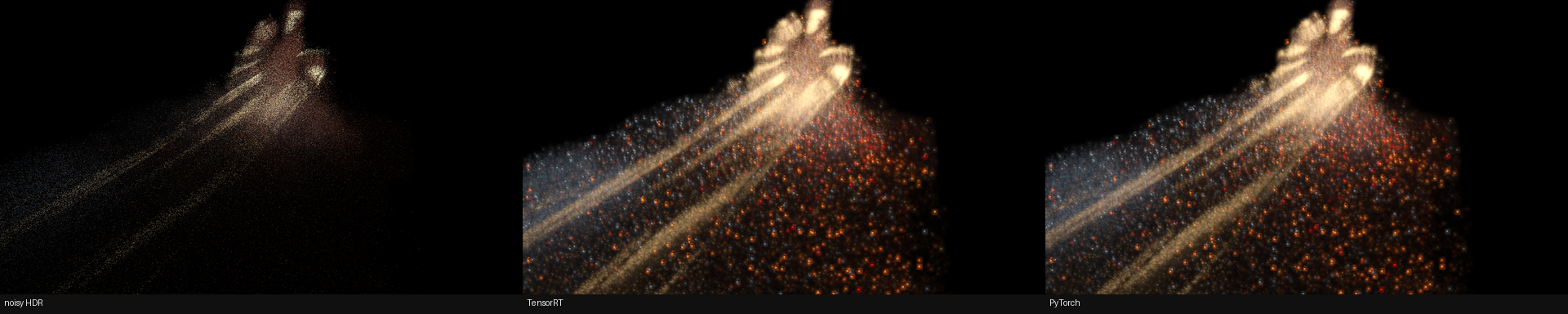
Earlier live deployment comparison with noisy HDR input, TensorRT output, and PyTorch output. This view checks agreement between execution paths; it is separate from a converged-reference image-quality comparison.
Recorded checks from September 18–21, 2026 cover raw volumetric sampling, the deployed neural model, and recurrent history. Reproducible capture tools connect GPU tensor dumps, Python analysis, PyTorch evaluation, and TensorRT execution.
Three static cases with path lengths of 1, 3, and 7 scattering events were tested at 640 × 360 on an RTX 5070 Ti. Each mode accumulated 1,024 frames after warm-up. Two independent native path-tracing reference splits provided 65,536 samples per pixel in total. Neural denoising and upscaling were disabled to isolate raw fog RGB.
These are static consistency checks against Nubix’s own native path tracer, which shares its SHARC-assisted lighting model. They do not establish equivalence to an external renderer or quality under motion.
The epoch-750 recurrent model was validated in a 1,040-frame live run at 1280 × 720. Four dense-fog captures passed guide-channel, finite-output, temporal-history, and analytic-opacity checks.
These checks validate deployment fidelity and history alignment, rather than denoising accuracy against a converged image. The 1080p TensorRT engine also built successfully; live deployment validation used 720p. Neural filtering remains optional.
Nubix brings together NVIDIA libraries, published rendering methods, and engine-specific simulation and reconstruction work. Its current rendering code builds on NVIDIA’s NRD Sample and NRI framework. The sources below credit that foundation and explain where each technology fits.
Unified Particle Physics for Real-Time Applications — Miles Macklin, Matthias Müller, Nuttapong Chentanez, and Tae-Yong Kim, 2014. FleX’s documentation identifies this paper as a foundation of its particle-based solver. Nubix uses that solver through FleX for its deformable objects.
Nubix’s contribution is the engine integration, extensions, interactive behavior, volumetric implementation, training workflow, and validation shown on this page. The upstream libraries and research methods remain credited to their respective authors. The links above describe the technologies; Nubix’s own captures and measurements document this integration.